
 View work
 ← Back to journal
Testing old lenses and Black Pro-Mist for black and white
Before filming Last of a Dying Breed, I thought I wanted the softness and character of vintage lenses. We put Roark Critchlow on a couch and compared older glass, modern lenses and Black Pro-Mist in black and white. Watching the test changed my mind: I wanted a modern, sharp, crisp, high-contrast image, with diffusion added only where we wanted it.

I thought I wanted vintage lenses. The test changed my mind.
The older lenses were what I wanted to explore at the start, not a look I had already ruled out. Once I saw the recorded comparisons, I preferred the sharper detail and stronger contrast of the modern lenses for this film. Black Pro-Mist then became something we could choose for particular shots, rather than building softness into everything through the lens choice.
The first comparison kept the Canon 10–22mm at 22mm and f/4.5 while the filter changed from no filter to 1/8 and then 1/4 Black Pro-Mist. With the bright window and small practical lights behind Roark, the change in the highlights is easy to see.

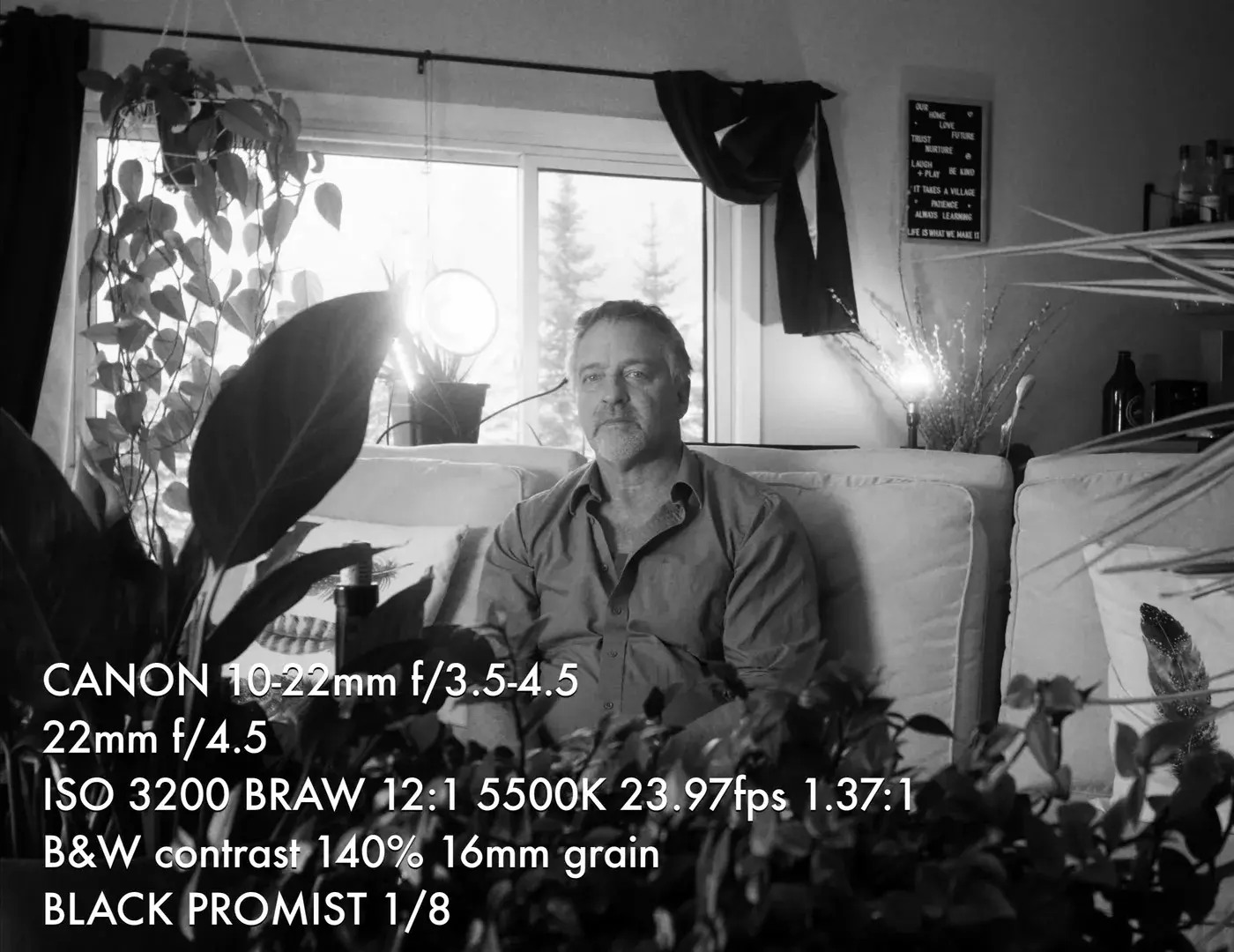

Watch the lens and filter comparison.
This three-minute, 34-second cut opens with a ten-second introduction. Each lens gets a six-second title card, followed by six seconds per picture pass. Each lens appears clean and then with 1/4 Black Pro-Mist; the Canon EF-S 10–22mm f/3.5–4.5 USM, tested at 22mm, also includes 1/8 between those passes. The complete lens name remains in the top-right label during every pass. The original camera annotations preserve the focal length and exposure used for each setup.
Two comparison tables at the end describe what is visible in the footage: face and shirt detail, shadows, and glow around the lights. Each stays up for 30 seconds, followed by a 30-second note about what we chose for the film. The same comparisons are below, so you can read them without pausing the video.
This is a working camera test rather than a scene from the film. Roark stays on the couch while focal length, framing and diffusion change around him, which makes it possible to compare the choices without pretending every difference came from the lens alone. The production audio has been removed and replaced with a quiet instrumental bed that fades gradually through the final ten seconds.
What we can see in these shots.
These are notes from looking at the recorded shots, not ratings taken from lens specifications. The wide shots make the shirt, plants and window easier to compare; the close-ups show more of Roark's face. That alone does not prove the 50mm lens is sharper than the 18–35mm.
We moved the camera for the 135mm Hanimax. Framing changed, and Roark also leans in and out of focus during parts of the test, particularly with the Helios. Those differences prevent a direct sharpness comparison. The table calls them out instead of treating every change as an effect of the lens or filter.
In the Canon sequence, 1/8 Black Pro-Mist adds less glow around the ring light than 1/4. The table uses 1/4 because that strength was recorded with all six lenses.
| Lens | No filter | Black Pro-Mist 1/4 |
|---|---|---|
| Canon EF-S 10–22mm f/3.5–4.5 USMTested at 22mm | Clear face outline and shirt folds. | More glow around the ring light. |
| Sigma 18–35mm f/1.8 DC HSM ArtTested at 18mm | Strong light and dark. Clear shirt folds. | More glow; shirt folds still clear. |
| Sigma 50mm f/1.4Tested at 50mm | Clear beard detail. Deep face shadows. | Beard detail remains; softer face shadows. |
| Berolina 28mm f/2.8Tested at 28mm | Soft face detail. Haze near the window. | More haze across the picture. |
| Helios 44-2 58mm f/2Tested at 58mm | Face goes soft as Roark leans forward. | Face clearer upright. Focus changed too. |
| Hanimax 135mm f/2.8Tested at 135mm | Clear hair detail. Deep face shadows. | Softer-looking face, but framing changed. |
The test belonged to the film.
The point was not to find the prettiest lens on its own. We needed a combination that could carry hard contrast, dark humour and faces through bars, porches, trucks, docks and night exteriors.
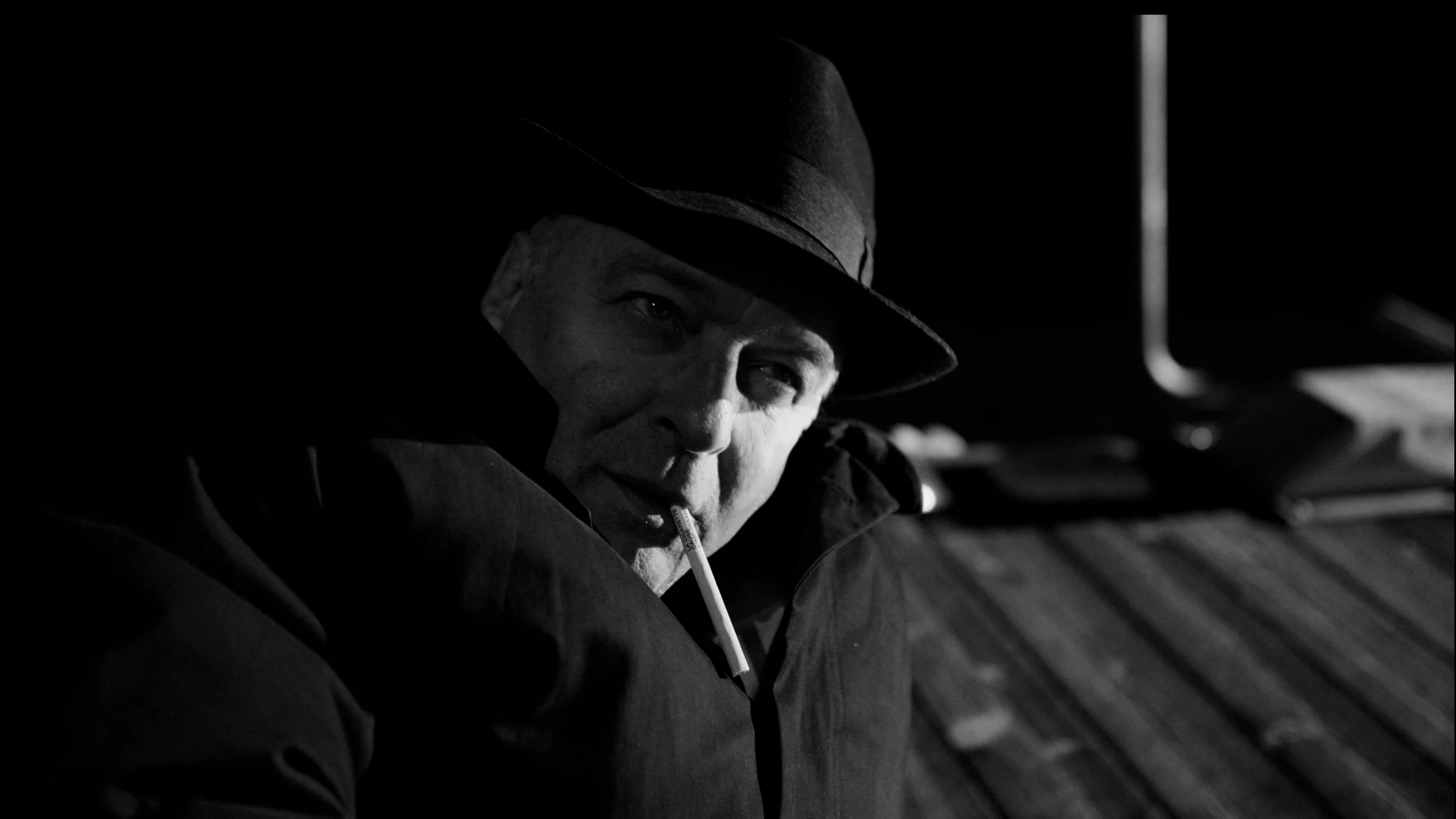
Last of a Dying Breed is a black-and-white neo-noir starring Roark Critchlow and Hannah Krostewitz. It remains in post-production. This test is one piece of the preparation behind the film and a useful record of the choices we were making before principal photography.
What carried into production.
We shot the main film on a RED KOMODO 6K, using both Sigmas alongside the Canon wide zoom. The camera files name the Sigma 18–35mm f/1.8 DC HSM Art and show it used across 18–35mm. They also record footage at 50mm and 10–22mm without naming those lenses in full. Our project records identify them as the Sigma 50mm f/1.4 and Canon EF-S 10–22mm f/3.5–4.5 USM.
The 2025 RED KOMODO-X pickup files record the Canon 10–22mm again, followed by Canon CN-E 24mm T1.5, 50mm T1.3 and 85mm T1.3 primes. One additional pickup set was recorded on a Blackmagic Pocket Cinema Camera 6K with the Canon 10–22mm.
I went in wanting vintage lenses. This test changed my mind: I wanted sharp detail and strong contrast, then the choice to add Black Pro-Mist for a softer shot. That is why we used the modern lenses. The camera files helped confirm the equipment; the reason for choosing it comes from watching this test.
Selected work
Related projects.
View work